
For short-term rental portfolio owners
Your STR playbook prints bookings.
Give it a fund structure that survives diligence.
Fund Launch AI converts your short-term rental operation — market selection, revenue management, design standards, and regulatory posture — into a structured fund: terms that acknowledge STR's real volatility, an interactive Scroll Deck, seasonally honest economics, and drafted LPA, PPM, and subscription inputs organized for review by qualified counsel.
Define the strategy and fund terms in one working record
Model economics from the same assumptions used in investor materials
Prepare an organized package for qualified counsel review
Illustrative only. Fund Launch AI provides software and educational tools. It does not provide legal, tax, investment, fundraising, or compliance advice. Any targets, returns, fees, timelines, model outputs, or fund terms shown are hypothetical examples and are not performance claims, projections, or guarantees. Fund formation, capital raised, regulatory approval, profitability, and investment results are not guaranteed.
The fund, in numbers
Structured the moment you describe it.
$100M
Target size
120
Doors modeled
8%
Preferred return
15%
Target gross IRR
150+
Structured fields
10 yr
Hold period
STR is hospitality wearing real estate's clothes
A fund holding nightly-rate assets can't be documented like a landlord
A short-term rental portfolio is operationally a hospitality business sitting on residential real estate — and the fund structure has to respect both halves. The revenue engine is nightly: ADR, occupancy, seasonality, channel mix, review velocity, and revenue-management skill drive returns the way rent rolls drive an apartment fund. That makes underwriting assumptions unusually load-bearing and unusually attackable — every LP has read a story about an STR market cratering. The risk profile is genuinely distinct: municipal regulation can reprice or eliminate an asset's licensed use, platform dependency concentrates distribution risk, and operating intensity (design, turnover, guest operations) makes the manager's systems part of the investment thesis. Structurally, that demands things a long-term rental template never contemplates: market-level regulatory criteria in the acquisition parameters, a written downside path (conversion to mid-term or long-term use), reserve policy sized to seasonality, distribution mechanics that don't promise smooth income from a lumpy business, and risk-factor language that treats regulation and platform concentration as the first-order issues they are. The strategy can absolutely be institutional. The documents have to get there first.
Investment mandate
Define the investments the fund may pursue and the boundaries of the mandate.
Capital and liquidity
Set deployment, reserve, leverage, and liquidity rules that match the assets and investor terms.
Operating responsibility
Record who sources, approves, monitors, values, and reports on each investment.
What LPs review
Show how the strategy, track record, team capacity, and downside controls support the proposed fund.
Sensitive fund terms
Explain fees, allocations, conflicts, distributions, and manager discretion before documents circulate.
Decision rules
Write the eligibility rules and approval authority clearly enough for the team and counsel to apply.
Generic fund language leaves these operating decisions unresolved.
Why STR raises stall
Great revenue screenshots, unserious paperwork
The STR world markets itself on gross-revenue screenshots — and that habit follows operators into fundraising. The deck shows peak months; the pro forma shows an annual average that hides seasonality; the terms come from a long-term rental syndication; and regulation gets one bullet on a risk slide. A skeptical LP (or any attorney) dismantles that package in minutes, not because the strategy is bad, but because the materials refuse to engage its actual risks.
The investment thesis uses language that never reaches the draft terms.
The model carries assumptions the investor materials do not explain.
Risk and liquidity decisions arrive after the economics are already set.
Fees and expenses are described differently across investor materials and counsel notes.
No current record shows who can approve exceptions or change the strategy.
Counsel receives fragments and spends review time reconstructing decisions the team already made.
The build
Take the risks seriously on paper — that's the credibility move
The way an STR fund earns trust is counterintuitive: lead with the discipline, not the screenshots. Fund Launch AI structures your build so the volatility is underwritten instead of averaged away, the regulatory screen is written into acquisition criteria, and the downside path is a documented plan. Your revenue skill still stars — but inside a package whose seriousness answers the skepticism before it's voiced, to LPs and to the counsel who reviews it.
01
Describe the fund you plan to run
Explain the mandate, target investments, proposed terms, team, and open decisions in plain English.
02
Structure the operating rules
Fund Builder organizes the strategy into fields for economics, risk, governance, reporting, and legal drafting.
03
Generate aligned fund materials
The Scroll Deck, economic model, term record, and legal inputs draw from the same fund information.
04
Review with qualified counsel
Send the organized record to a Fund Launch partner law firm or your own attorney. Legal review starts with the fund record instead of a blank page.
The package
Materials that convert skeptics instead of avoiding them
STR diligence is adversarial by default — the sector's marketing excesses guaranteed that. So the package is built to win an adversarial read: performance shown at monthly resolution, a regulatory screen written as acquisition policy, reserves and distribution mechanics sized to seasonality, a documented conversion path as the downside plan, and risk factors that name regulation, platform concentration, and demand shocks in plain language. When the skeptical LP goes looking for the evasion, they find engagement instead. That's the whole game.
Investment thesis and mandate with defined boundaries
Scroll Deck tied to the fund's current strategy and economics
Fund structure and terms based on the manager's operating plan
Economic scenarios using the proposed fees and distribution rules
Legal drafting inputs for the LPA, PPM, and subscription documents
Risk-factor inputs drawn from the strategy and operating record
Capital deployment and reporting policies prepared for LP review
Attorney-review package with the current decision record
What the platform asks you
The fields an STR fund turns on
These inputs make the build STR-native — structured, scored, and threaded through every output.
200+
structured fields
The diligence you'll face
The skeptic's script — answered in advance
Assume every LP has read the STR-crash thinkpieces. Their questions are predictable, which means they're preparable.
01
Why should I invest in your fund instead of buying rentals myself?
02
What stops you from stretching the buy box when deal flow gets thin?
03
Your expense assumptions — turns, maintenance, insurance — look tight. What's the evidence?
04
Who manages 150 scattered doors, and what happens when your PM underperforms?
05
When refinances return capital, does it come back to me or get recycled — and who decides?
06
How do acquisition fees work when you're buying forty houses a year?
07
What's the exit: portfolio sale to an aggregator, retail one-offs, or indefinite hold?
08
What happened on your worst deal, and what changed because of it?
Each answer already lives in your build. The ban question is answered by the regulatory screen and conversion-path policy in your acquisition criteria. The ADR question is answered by monthly-resolution history in the Scroll Deck. The trough question is answered by reserve sizing and distribution mechanics in the documents. Fund Launch AI structures those answers and benchmarks the terms around them — so the skeptic's script becomes your best material instead of your worst meeting.
Term sensitivity
Eight terms an STR fund is judged on
01
Investment mandate and manager discretion
With continuous deal flow, the written buy box is the LP's only protection against drift. Too loose and it's meaningless; too tight and you can't deploy. This is the term SFR LPs read first.
02
Management fees and expense allocation
A per-deal fee that's reasonable on one house becomes a headline number across forty. The fee architecture has to be modeled at full pacing, not per transaction.
03
Investment allocation and conflicts
BRRRR-adjacent economics live or die on whether refi proceeds can redeploy. Silence here creates a fight later; clarity here is a selling point.
04
Investor liquidity and distribution terms
SFR cash flow is steady but refinance events are lumpy. LPs need to know what's distributed monthly or quarterly versus held for redeployment.
05
Leverage and borrowing authority
Portfolio debt, cross-collateralization, and rate exposure across many small loans need explicit boundaries — this is where downside scenarios concentrate.
06
Valuation and investor reporting
Fee on committed versus deployed capital changes your incentive to pace acquisitions honestly, and LPs in high-velocity strategies check.
07
Capital use and reinvestment authority
Scattered-site portfolios eat capital in turns, roofs, and HVAC. A stated per-door and fund-level reserve converts the biggest operational fear into a documented plan.
08
Key-person and governance provisions
Most SFR funds are one operator's system. LPs will ask what happens to their capital if that operator is gone — the documents should answer before they ask.
One Connected System for Your Fund
Build your fund
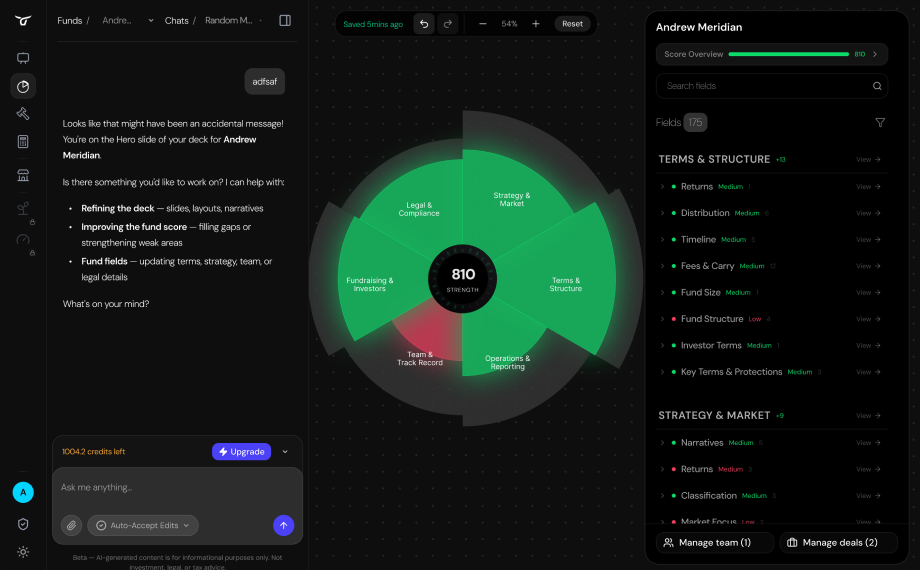
Fund Builder
Turn 200+ fields into one clear record for your strategy, terms, fees, and risks.
Prepare legal inputs

Legal Canvas
Organize legal inputs from the same fund record. Send them to qualified counsel for review.
Present the fund

Scroll Deck
Share a clear investor story built from the same facts. Keep it tied to your terms and numbers.
Fit check
Who this build is for
Old way
Rewrite your strategy in every file
Keep your deck, model, and terms in separate tools
Track each change by hand
Send scattered notes to your lawyer
Find gaps during LP review
New way
Record each key choice once
Use one record for your deck, model, and terms
Keep connected work tied to the same facts
Send organized inputs to qualified counsel
Fix gaps before the first serious LP call
FAQ
Frequently asked questions
Can a short-term rental portfolio really support a fund structure?
Structurally, yes — the build treats STR as what it is: a hospitality operation on real estate, with regulatory screens in the acquisition criteria, seasonality in the economics, and a documented conversion fallback. Whether a pooled vehicle fits your specific situation is a question for qualified counsel; the platform gets you to that conversation organized and credible.
Does it replace my attorney?
No — and in STR you'll want counsel engaged early, because regulatory posture matters. The platform hands them a drafted package where the screens, fallback provisions, and risk language already exist and match your deck and economics. They review drafted work, apply legal judgment, and finalize; one click reaches a partner firm, or bring your own.
How does the deck handle STR's credibility problem?
By leading with discipline. The Scroll Deck presents monthly-resolution performance, seasonality curves, the regulatory screen, and the downside plan in the order a skeptic evaluates — so the evasions they're hunting for simply aren't there. Your revenue skill lands harder inside a serious frame.
Can it model seasonal economics and holdbacks?
Yes. Trough months, distribution holdbacks, reserve draws, and the full fee stack are explicit model mechanics tied to the same terms in your drafted documents — built to survive the LP who rebuilds your numbers independently.
Can it help draft regulatory and platform risk language?
Yes. Risk-factor drafting inputs treat municipal regulation, platform dependency, seasonality, and demand shocks as the first-order STR risks they are, written to your markets and posture. Your attorney refines and finalizes — from substance, not from a blank section.
My markets have different regulatory regimes. Can the build handle that?
Yes. The regulatory screen is written as criteria — permitting regime, caps, enforcement history — that qualify or disqualify markets and assets, rather than as one blanket statement. Market-level differences become documented policy your acquisition parameters enforce.
What happens when my terms change?
One edit updates the package: resize reserves, adjust a holdback, tighten the screen, and the Scroll Deck, economics, and drafted legal inputs move together with the change re-benchmarked. Diligence never finds a stale version.
Is this legal, tax, investment, or compliance advice?
No. Fund Launch AI drafts, structures, models, and benchmarks; it does not advise and is not a law firm, broker-dealer, or registered investment adviser. In a regulation-sensitive strategy like STR, qualified professionals are non-optional — the platform exists to make their review start from your best, most organized work.
Serious structure for a doubted strategy
Let the skeptics read the documents. That's the pitch.
Describe your STR operation — markets, systems, seasonality, fallback plan. Get back a structured fund whose terms, economics, and drafted legal inputs engage the hard questions before anyone asks them, ready for qualified counsel.
Fund Launch AI provides software, educational tools, templates, and strategic guidance only. Fund Launch is not a broker-dealer, registered investment adviser, law firm, tax adviser, placement agent, or funding source. It does not provide legal, tax, investment, fundraising, or compliance advice; offer or sell securities; solicit investors; provide clients or deals; assign a business model; or guarantee fund formation, capital raised, regulatory approval, profitability, earnings, or investment results. Nothing on this page is an offer to sell or a solicitation of an offer to buy securities, a franchise, distributorship, passive-income system, earnings program, or other business opportunity. Users must bring and define their own strategy, source their own opportunities and investors, conduct their own diligence, and remain responsible for operations, fundraising, compliance, and investment decisions. All examples, targets, model outputs, returns, fees, timelines, and fund terms are illustrative and may not reflect actual results. Outputs are drafts and must be reviewed by qualified legal, tax, accounting, and compliance professionals. Engagement of a preferred law firm is separate and subject to that firm's own terms; Fund Launch does not control or guarantee the firm's services. Past results, if any, are not indicative of future outcomes.