
For managers acquiring investment advisory firms
Build the fund around AUM revenue quality and the terms LPs will check.
Fund Launch AI helps you document AUM revenue quality, advisor retention plan, fiduciary compliance process, and client transferability review, then prepares fund terms, a Scroll Deck, waterfall economics, and LPA, PPM, and subscription inputs from one working record. One click sends the package to an in-platform partner law firm that already knows the document set.
Define the strategy and fund terms in one working record
Model economics from the same assumptions used in investor materials
Prepare an organized package for qualified counsel review
Illustrative only. Fund Launch AI provides software and educational tools. It does not provide legal, tax, investment, fundraising, or compliance advice. Any targets, returns, fees, timelines, model outputs, or fund terms shown are hypothetical examples and are not performance claims, projections, or guarantees. Fund formation, capital raised, regulatory approval, profitability, and investment results are not guaranteed.
The fund, in numbers
Structured the moment you describe it.
$100M
Target size
120
Doors modeled
8%
Preferred return
15%
Target gross IRR
150+
Structured fields
10 yr
Hold period
The strategy has its own rules
The fund has to make AUM revenue quality explicit
This strategy needs written rules for AUM revenue quality, advisor retention plan, fiduciary compliance process, and client transferability review. LPs will ask what qualifies, how decisions are approved, what happens when assumptions miss, and what reporting shows after capital is deployed. The documents need to make the manager's discipline visible before the first diligence call. Fund Launch AI turns that discipline into fund terms, model assumptions, risk language, and draft legal inputs that all say the same thing.
Investment mandate
Define the investments the fund may pursue and the boundaries of the mandate.
Capital and liquidity
Set deployment, reserve, leverage, and liquidity rules that match the assets and investor terms.
Operating responsibility
Record who sources, approves, monitors, values, and reports on each investment.
What LPs review
Show how the strategy, track record, team capacity, and downside controls support the proposed fund.
Sensitive fund terms
Explain fees, allocations, conflicts, distributions, and manager discretion before documents circulate.
Decision rules
Write the eligibility rules and approval authority clearly enough for the team and counsel to apply.
Generic fund language leaves these operating decisions unresolved.
Where fund materials usually drift
A deck, a model, and legal inputs built from different memories
The usual path starts with a category deck, a single-deal model, and legal inputs assembled later. That leaves the manager explaining important choices from memory: AUM revenue quality, advisor retention plan, fiduciary compliance process, and client transferability review. LPs notice when the deck, model, and draft terms use different assumptions. The partner law firm also has to spend time reconstructing choices that should have been written down before review began.
The investment thesis uses language that never reaches the draft terms.
The model carries assumptions the investor materials do not explain.
Risk and liquidity decisions arrive after the economics are already set.
Fees and expenses are described differently across investor materials and counsel notes.
No current record shows who can approve exceptions or change the strategy.
Counsel receives fragments and spends review time reconstructing decisions the team already made.
The build
Describe the strategy once, then keep every output tied to it
Fund Launch AI starts with the way you already describe the strategy. You explain the market, the opportunity set, the terms you are considering, and the parts that still need work. The platform turns that description into structured data, asks for the missing pieces at the right time, and keeps the deck, model, and legal inputs tied to the same record.
01
Describe the fund you plan to run
Explain the mandate, target investments, proposed terms, team, and open decisions in plain English.
02
Structure the operating rules
Fund Builder organizes the strategy into fields for economics, risk, governance, reporting, and legal drafting.
03
Generate aligned fund materials
The Scroll Deck, economic model, term record, and legal inputs draw from the same fund information.
04
Review with qualified counsel
Send the organized record to a Fund Launch partner law firm or your own attorney. Legal review starts with the fund record instead of a blank page.
The package
A fund package built around the strategy's real mechanics
The package answers four questions: what qualifies, what gets rejected, how economics are measured, and how risk is reported. Fund Launch AI drafts each artifact from the same working record, so a change to a term or assumption does not create a contradiction somewhere else.
Investment thesis and mandate with defined boundaries
Scroll Deck tied to the fund's current strategy and economics
Fund structure and terms based on the manager's operating plan
Economic scenarios using the proposed fees and distribution rules
Legal drafting inputs for the LPA, PPM, and subscription documents
Risk-factor inputs drawn from the strategy and operating record
Capital deployment and reporting policies prepared for LP review
Attorney-review package with the current decision record
What the platform can handle
Inputs this fund build can work through with you
You do not need every answer before you start. Fund Builder uses these inputs to help you think through the strategy, test the terms, and turn the parts you do know into a working fund build.
200+
structured fields
The diligence conversation
The questions your materials should answer cleanly
LP questions should not force you to rebuild the strategy in real time. They should point back to fields already captured in the fund build.
01
Why should I invest in your fund instead of buying rentals myself?
02
What stops you from stretching the buy box when deal flow gets thin?
03
Your expense assumptions — turns, maintenance, insurance — look tight. What's the evidence?
04
Who manages 150 scattered doors, and what happens when your PM underperforms?
05
When refinances return capital, does it come back to me or get recycled — and who decides?
06
How do acquisition fees work when you're buying forty houses a year?
07
What's the exit: portfolio sale to an aggregator, retail one-offs, or indefinite hold?
08
What happened on your worst deal, and what changed because of it?
Each question maps to a structured input in Fund Builder. The answer can then appear consistently in the Scroll Deck, waterfall, legal drafting inputs, and partner-firm handoff package.
Term sensitivity
Terms that need to reflect how this strategy actually works
01
Investment mandate and manager discretion
With continuous deal flow, the written buy box is the LP's only protection against drift. Too loose and it's meaningless; too tight and you can't deploy. This is the term SFR LPs read first.
02
Management fees and expense allocation
A per-deal fee that's reasonable on one house becomes a headline number across forty. The fee architecture has to be modeled at full pacing, not per transaction.
03
Investment allocation and conflicts
BRRRR-adjacent economics live or die on whether refi proceeds can redeploy. Silence here creates a fight later; clarity here is a selling point.
04
Investor liquidity and distribution terms
SFR cash flow is steady but refinance events are lumpy. LPs need to know what's distributed monthly or quarterly versus held for redeployment.
05
Leverage and borrowing authority
Portfolio debt, cross-collateralization, and rate exposure across many small loans need explicit boundaries — this is where downside scenarios concentrate.
06
Valuation and investor reporting
Fee on committed versus deployed capital changes your incentive to pace acquisitions honestly, and LPs in high-velocity strategies check.
07
Capital use and reinvestment authority
Scattered-site portfolios eat capital in turns, roofs, and HVAC. A stated per-door and fund-level reserve converts the biggest operational fear into a documented plan.
08
Key-person and governance provisions
Most SFR funds are one operator's system. LPs will ask what happens to their capital if that operator is gone — the documents should answer before they ask.
One Connected System for Your Fund
Build your fund
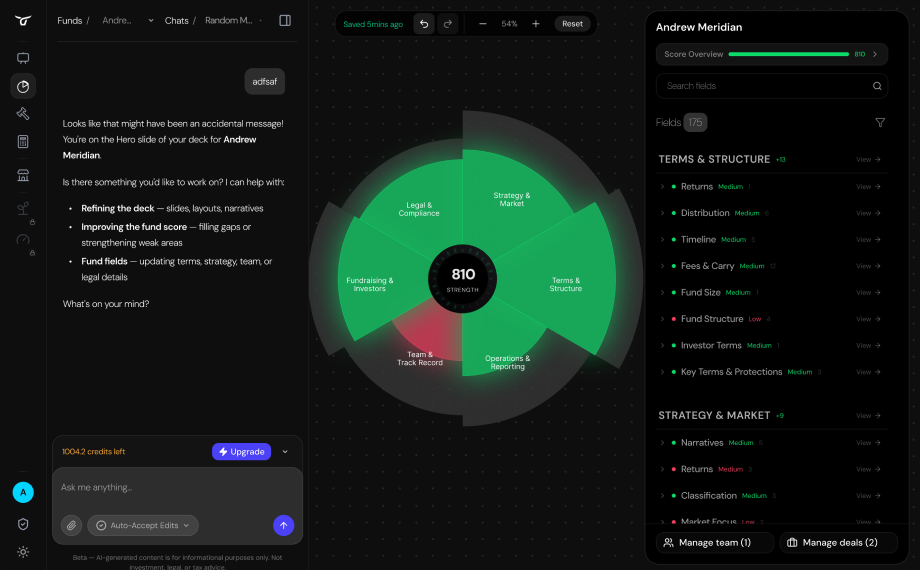
Fund Builder
Turn 200+ fields into one clear record for your strategy, terms, fees, and risks.
Prepare legal inputs

Legal Canvas
Organize legal inputs from the same fund record. Send them to qualified counsel for review.
Present the fund

Scroll Deck
Share a clear investor story built from the same facts. Keep it tied to your terms and numbers.
Fit check
Who this build is for
Old way
Rewrite your strategy in every file
Keep your deck, model, and terms in separate tools
Track each change by hand
Send scattered notes to your lawyer
Find gaps during LP review
New way
Record each key choice once
Use one record for your deck, model, and terms
Keep connected work tied to the same facts
Send organized inputs to qualified counsel
Fix gaps before the first serious LP call
FAQ
Frequently asked questions
Can Fund Launch AI help with managers acquiring investment advisory firms specifically?
Yes. The build is shaped around AUM revenue quality, advisor retention plan, fiduciary compliance process, and client transferability review. You can start with plain-language notes, existing materials, or a rough fund idea. Fund Builder turns that into structured inputs and keeps asking for the details that matter for this strategy.
Does it replace my attorney?
No. Fund Launch AI is built to work with in-platform partner law firms that already know the document set. The platform organizes the draft inputs, model, Scroll Deck, and decision record for that handoff. The partner firm handles the legal work and brings you in for one final review call before documents are completed.
Do I need every input answered before I start?
No. The platform is built for early strategy work as well as cleaner final preparation. If you are still deciding on AUM revenue quality or advisor retention plan, the build helps you compare choices and see what each one changes.
Can it build the Scroll Deck for this strategy?
Yes. The Scroll Deck is generated from the same working record as the model and draft legal inputs, so the pitch reflects the terms and stays tied to the documents.
Can it model the economics?
Yes. The waterfall and economics module reads the fund terms from Fund Builder and models fees, distributions, reserves, and scenarios from those terms. The model is a preparation tool and remains subject to partner-firm and professional review.
How does partner law firm review work?
When the build is ready, one click sends the organized package to an in-platform Fund Launch partner law firm. The firm receives the draft inputs in a familiar format, handles the legal work, and brings you in for a final review call.
Is any of this legal, tax, investment, or compliance advice?
No. Fund Launch AI prepares drafts, models, benchmarks, and handoff materials. It does not provide legal, tax, investment, or compliance advice and is not a law firm, broker-dealer, or registered investment adviser. Legal documents are reviewed and finalized through an in-platform partner law firm.
Build from the strategy you actually run
Structure the fund before the documents start moving.
Describe your strategy in plain English. Fund Launch AI turns it into terms, a Scroll Deck, waterfall economics, and draft legal inputs that route to an in-platform partner law firm in one click.
Fund Launch AI provides software, educational tools, templates, and strategic guidance only. Fund Launch is not a broker-dealer, registered investment adviser, law firm, tax adviser, placement agent, or funding source. It does not provide legal, tax, investment, fundraising, or compliance advice; offer or sell securities; solicit investors; provide clients or deals; assign a business model; or guarantee fund formation, capital raised, regulatory approval, profitability, earnings, or investment results. Nothing on this page is an offer to sell or a solicitation of an offer to buy securities, a franchise, distributorship, passive-income system, earnings program, or other business opportunity. Users must bring and define their own strategy, source their own opportunities and investors, conduct their own diligence, and remain responsible for operations, fundraising, compliance, and investment decisions. All examples, targets, model outputs, returns, fees, timelines, and fund terms are illustrative and may not reflect actual results. Outputs are drafts and must be reviewed by qualified legal, tax, accounting, and compliance professionals. Engagement of a preferred law firm is separate and subject to that firm's own terms; Fund Launch does not control or guarantee the firm's services. Past results, if any, are not indicative of future outcomes.